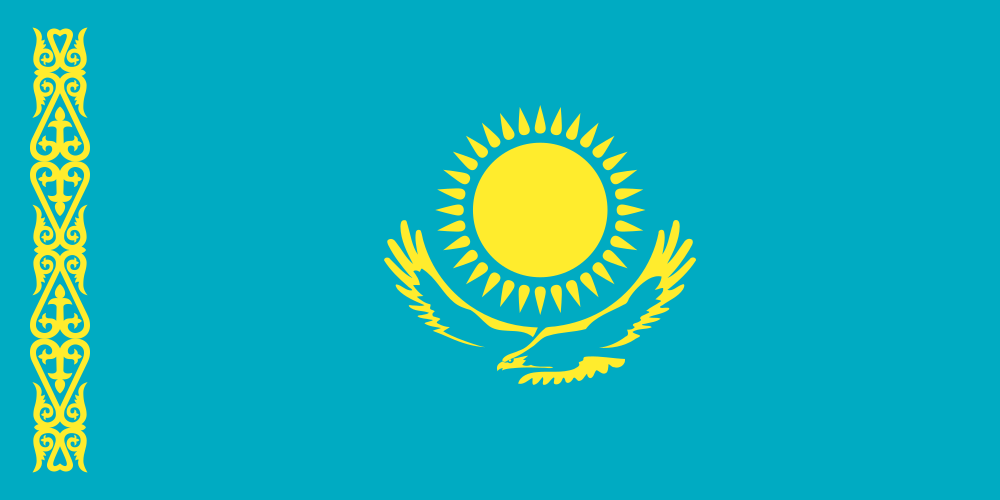
It is easy to think of Almaty simply as the former capital of Kazakhstan. In reality, the city retained enormous cultural, economic, and tourist importance even after the capital was moved.
As of June 1, 2026, Almaty had a population of around 2.37 million people, making it the largest city in Kazakhstan.
But numbers are not what make Almaty interesting to travelers.
The defining feature of the city is its position directly below the Trans-Ili Alatau, part of the northern Tien Shan. You can drink coffee in the center of a city of more than two million people in the morning and, only a few hours later, find yourself surrounded by mountain slopes and high-altitude landscapes.
This proximity to the mountains has shaped the character of Almaty.
Medeu, Shymbulak, Kok-Tobe, and the numerous valleys and hiking routes around the city feel less like distant excursions and more like extensions of urban life.
At the same time, Almaty contains several very different historical layers: pre-Russian settlements, the imperial city of Verny, Soviet Alma-Ata, and the modern Kazakh metropolis.
That is why it is more interesting to explore Almaty by understanding how the city repeatedly changed its name, status, and identity rather than simply checking attractions off a map.
History of Almaty
The history of Almaty began long before the foundation of Verny.
Archaeological discoveries show that people lived in the foothills of the Tien Shan for many centuries. The area was connected with settlements and trade routes long before the arrival of the Russian Empire.
The common idea that Almaty's history began with a Russian fortress in the 19th century therefore oversimplifies the city's past.
Medieval Almaty
The name Almaty itself has much deeper roots than the Soviet name Alma-Ata.
During the medieval period, settlements existed in this part of Zhetysu along regional trade routes. Names similar to Almaty and Almatu were used long before the foundation of Verny.
This is important because the modern name of the city essentially reconnects it with an older historical layer.
And this brings us to the best-known symbol of Almaty — the apple.
Why Is Almaty Called the City of Apples?
Almaty's connection with apples is more than a convenient city legend.
The Kazakh word alma means "apple," and the name Almaty has traditionally been associated with a place rich in apples.
But the story becomes much more interesting when you leave the city and move into the mountains.
The Tien Shan around Almaty is a natural habitat of Malus sieversii, the wild Sievers apple. Modern genetic research has shown that this Central Asian species is a major ancestor of today's domesticated apple.
This means Almaty's association with apples goes much deeper than modern branding.
The ancestors of apples now sold in supermarkets across Europe, Asia, and the Americas are closely connected with the wild apple forests of Central Asia.
In the early 20th century, the famous scientist Nikolai Vavilov also studied the remarkable diversity of apples around Almaty and recognized the region's importance in the history of the cultivated apple. Modern genetics has further demonstrated the central role of Malus sieversii.
This is why apples appear everywhere in Almaty — in city symbols, souvenirs, names, and stories told by local guides.
From Verny to Alma-Ata
The modern urban history of Almaty changed dramatically in 1854, when the Russian Empire established the military fortification of Vernoye, later known as Verny.
A town gradually developed around the fort.
The location was practical: there was access to water, fertile land, mountains, and routes connecting different parts of Zhetysu.
Over time, the military settlement developed into an administrative and commercial center.
Verny
The name Verny still appears frequently when discussing the history of Almaty.
Relatively little of the old city has survived, especially compared with the historic centers of cities such as Samarkand or Bukhara. Earthquakes, Soviet redevelopment, and modern construction significantly transformed Almaty.
However, several surviving buildings and parts of the old street plan still provide glimpses of the city before the appearance of the broad avenues associated with Soviet Alma-Ata.
The Earthquake That Changed the City
The mountains gave Almaty water, cooler air, and its dramatic backdrop, but they also created one of the region's major natural risks — earthquakes.
In the late 19th and early 20th centuries, powerful earthquakes caused serious damage to Verny.
The 1887 earthquake was particularly destructive.
After the disaster, building safely in a seismic zone was no longer an abstract concern. Architects and engineers had to find construction methods that could better withstand future earthquakes.
One of Almaty's most recognizable historic buildings is connected with this period — the Ascension Cathedral, also widely known as Zenkov Cathedral.
Its wooden structure later survived the powerful 1911 earthquake, and today the cathedral remains one of the main surviving symbols of old Almaty.
Alma-Ata and the Soviet Period
After the Russian Revolution, the city changed again.
During the Soviet period, the name Alma-Ata became established and eventually became known far beyond Kazakhstan.
A major turning point came in 1929, when Alma-Ata became the capital of the Kazakh ASSR and later the Kazakh SSR.
The capital period shaped much of the city travelers see today.
Government institutions, universities, theaters, scientific institutes, broad avenues, parks, and new residential districts appeared as the city expanded.
Alma-Ata gradually became one of the major cultural and intellectual centers of Soviet Central Asia.
Why Does Almaty Have So Much Soviet Architecture?
Walk through Almaty carefully and the Soviet period is impossible to miss.
The city preserves modernist buildings, monumental administrative complexes, hotels, cultural centers, apartment blocks, mosaics, and public spaces from different decades of the USSR.
The architecture of the second half of the 20th century is particularly interesting.
Alma-Ata was expected to look like the capital of a Soviet republic, but architects also experimented with local motifs and tried to respond to the surrounding mountain landscape.
As a result, Soviet architecture and monumental art have become a separate reason to explore Almaty, especially for travelers interested in modernism, mosaics, and urban history.
Almaty – The Former Capital of Kazakhstan
After the collapse of the Soviet Union, Almaty became the capital of independent Kazakhstan.
That period did not last long.
In 1997, the country's capital functions were transferred from Almaty to Akmola, the city that would later become Astana.
Almaty lost its official capital status but did not lose its importance.
This explains why it is still commonly referred to as Kazakhstan's "southern capital."
For travelers, the scale of the city makes this immediately understandable.
Almaty does not feel like a former capital left behind by history. It remains a major center for business, universities, restaurants, museums, cultural projects, and tourism in southeastern Kazakhstan.
Legends of Almaty
Almaty does not have one single legend that explains the entire origin of the city.
Instead, local stories are connected with apples, mountains, and the ancient settlements that existed in the area.
The Legend of the City of Apples
The best-known story is naturally connected with the name Almaty.
In popular versions of the story, this land is described as a place where apples grew long before the modern city appeared. Travelers and local communities encountered apple forests in the foothills, and the area gradually became associated with the fruit.
What makes this story particularly interesting is that science supports an important part of it.
Wild Sievers apple trees really do grow in the region, and genetic studies connect them directly with the ancestry of modern cultivated apples.
It is a rare example of a city legend that comes surprisingly close to genuine botanical history.
The Mountains – Protection and Danger
Many local stories are also connected with the mountains.
For centuries, the Trans-Ili Alatau provided people with water, pasture, forests, and natural protection. At the same time, the mountains brought earthquakes, avalanches, and destructive mudflows.
This dual relationship helps explain Almaty's connection with its landscape.
The city has always wanted to live close to the mountains while simultaneously having to protect itself from the natural forces coming from them.
This story becomes particularly important around Medeu, where travelers can see not only the famous high-altitude skating rink but also the major mudflow protection dam above the city.
Almaty Today
Today, Almaty has a population of approximately 2.37 million people and continues to grow.
It is a university, financial, restaurant, tourist, and cultural center with a young and constantly changing urban rhythm.
Modern Almaty is changing quickly.
New public spaces, coffee shops, restaurants serving contemporary Kazakh cuisine, local fashion brands, galleries, and projects by young designers are appearing throughout the city.
At the same time, Soviet-era markets, traditional canteens, old residential districts, and small family-run businesses continue to operate nearby.
And all of this exists directly below the mountains.
Why Do So Many Central Asia Trips Start in Almaty?
For international travelers, Almaty is one of the most convenient starting points for a larger journey through Central Asia.
The reason is not only the city itself.
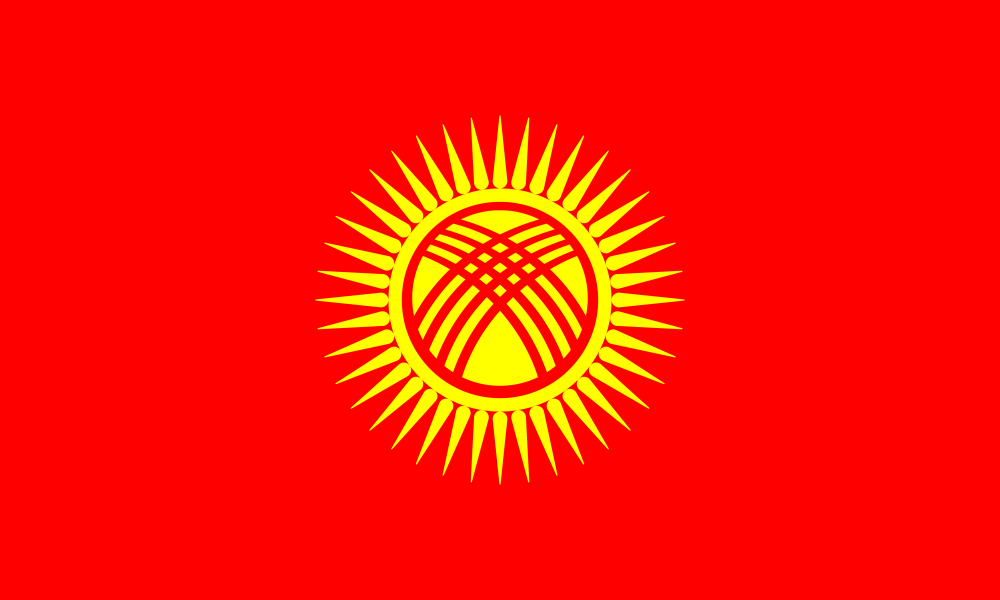
Almaty can easily be combined with natural destinations in southeastern Kazakhstan before continuing into Kyrgyzstan. This is why regional itineraries often begin here and then continue toward Bishkek, Issyk-Kul, Karakol, and other destinations.
Spending several days in Almaty also provides a comfortable introduction to Central Asia. Travelers can try Kazakh cuisine, explore Soviet heritage, experience contemporary urban culture, and then continue toward mountains and smaller towns.
For Ulush Travel, Almaty can also serve as a logical starting point for combined Kazakhstan and Kyrgyzstan itineraries.
Main Attractions in Almaty
Below are the main places to know for a first visit. The practical side of exploring the city can be covered in more detail in the second part.
Kok-Tobe
Kok-Tobe is a hill above the city and one of Almaty's best-known viewpoints.
The main reason to visit is the panorama. On one side, you can see the enormous city spreading across the plain; on the other, the proximity of the Trans-Ili Alatau becomes obvious.
Late afternoon is a particularly good time to visit. You can see Almaty in daylight and stay as the city lights begin to appear after sunset.
Medeu
Medeu is much more than its famous skating rink.
The high-altitude sports complex sits in a mountain valley above Almaty and was one of the best-known symbols of Soviet sport. Its elevation, mountain climate, and ice conditions helped make it famous far beyond Kazakhstan.
For travelers, however, the route does not have to end at the rink.
From Medeu, the mountains continue toward Shymbulak, hiking areas, and the large mudflow protection dam.
Shymbulak
Higher in the mountains is Shymbulak, the main ski area near Almaty.
In winter, visitors come for skiing and snowboarding. During the warmer months, cable cars provide easy access to higher elevations and mountain scenery.
The most remarkable feature of Shymbulak is its proximity to the city.
You can begin the morning in Almaty's traffic and, within a relatively short time, find yourself high in the mountains.
Panfilov Park and Ascension Cathedral
The Park of 28 Panfilov Guardsmen is one of the key historical areas in central Almaty.
Here, Soviet memorial history stands next to the colorful wooden Ascension Cathedral dating from the early 20th century.
It is a useful place for understanding the different historical layers of Almaty. Within a relatively small area, travelers can move from the history of imperial Verny to Soviet Alma-Ata and then back into the modern city.
Green Bazaar
To understand Almaty beyond its architecture and mountains, visit the Green Bazaar.
Do not focus only on souvenirs.
Dried fruit, nuts, kurt, meat products, spices, fresh fruit, and other foods provide a quick introduction to the cuisine of Kazakhstan and the wider region.
And this is also a good place to return to the story of the apple — the fruit that connects modern Almaty with the wild forests of the Tien Shan and the much older history of the region.
More Places to See in Almaty
Central State Museum of Kazakhstan
If you want to understand Kazakhstan beyond its Soviet history, the Central State Museum is worth visiting. Its collections cover archaeology, nomadic culture, ethnography, and different periods of the country's history.
The museum is particularly useful at the beginning of a longer journey through Kazakhstan. After visiting it, many symbols, ornaments, traditional objects, and customs you encounter later become easier to understand.
Republic Square
Republic Square is closely connected with the modern history of Kazakhstan.
The Independence Monument stands here, and the square has long been one of the city's important public spaces. It can easily be combined with a walk through central Almaty and its Soviet-era architecture.
Zhibek Zholy and the Arbat
The pedestrian section of Zhibek Zholy, commonly known as the Arbat, is a good place for a relaxed walk through the city center.
Street musicians, artists, cafés, shops, and local residents give this part of Almaty a completely different atmosphere from the historical sites of old Verny.
Where to Eat in Almaty
Almaty is one of the best cities in the region for exploring both traditional Kazakh food and contemporary Central Asian cuisine.
In a single day, you can move from beshbarmak and baursak to Uyghur lagman, then finish the evening at a restaurant offering a modern interpretation of traditional Kazakh ingredients.
Kazakh Cuisine
For a first introduction, try beshbarmak, kazy, baursak, kuurdak, and sorpa.
Also try kurt, a dried fermented dairy product historically well suited to nomadic life because it could be stored for long periods and transported easily.
Uyghur Cuisine
Almaty is also an excellent place to discover Uyghur cuisine.
Start with lagman made with hand-pulled noodles, then try manty and different meat dishes. This cuisine is also a reminder that Almaty's cultural history is connected not only with the Kazakh steppe but with the wider Zhetysu region and neighboring Xinjiang.
Contemporary Kazakh Cuisine
Almaty's restaurant scene has developed considerably, with more chefs working with local ingredients and presenting traditional Kazakh food in new ways.
It is worth leaving at least one evening for contemporary Kazakh cuisine rather than eating only familiar plov, lagman, or kebabs throughout the trip.
Things to Do in Almaty
Visit Kok-Tobe in the Evening
Kok-Tobe is best saved for the second half of the day.
This gives you a chance to see Almaty in daylight, stay for sunset, and watch the lights gradually appear across the city.
Spend Half a Day at Medeu and Shymbulak
Allow at least half a day for Medeu and Shymbulak.
Do not travel all the way to Medeu only to photograph the skating rink. If the cable cars are operating and the weather is good, continue higher into the mountains.
This is where you really understand how unusually close a major mountain range is to a city of more than two million people.
Plan a Food Day
Start with a local breakfast, visit Green Bazaar later in the morning, try lagman for lunch, and finish with contemporary Kazakh cuisine in the evening.
For some travelers, a day like this reveals as much about modern Almaty as a traditional sightseeing tour.
Almaty as a Starting Point for Kazakhstan
Almaty is a convenient base for exploring southeastern Kazakhstan.
Some of the best-known destinations include Charyn Canyon, Kolsai Lakes, Kaindy Lake, and Altyn-Emel National Park.
However, distances can be deceptive.
Many places look relatively close to Almaty on a map, but reaching them can take a significant part of the day. If you want to see several natural destinations, a multi-day route is usually better than returning to Almaty every evening.
From Almaty to Kyrgyzstan
Almaty combines naturally with a journey through Kyrgyzstan.
One of the most logical routes continues toward Bishkek, followed by Issyk-Kul, Karakol, and other parts of the country.
This is why Almaty often becomes the first stop on a combined Kazakhstan + Kyrgyzstan itinerary. For international travelers, the border does not need to feel like the end of one journey and the beginning of another — the two countries work very well within a single Central Asian route.
Useful Tips
- Allow at least 2–3 days for Almaty itself, not including trips to Charyn, Kolsai, or other destinations outside the city.
- Visit Medeu and Shymbulak in clear weather whenever possible. Mountain clouds can completely change visibility.
- Even in summer, carry an extra layer of clothing when heading high into the mountains.
- Visit Green Bazaar earlier in the day rather than shortly before closing.
- Almaty is a large city with serious traffic, so do not plan your day based only on distances shown on the map.
- Allow plenty of travel time for destinations outside the city.
- If continuing to Kyrgyzstan, check the current border-entry requirements for your nationality before traveling.
Frequently Asked Questions
How Many Days Do You Need in Almaty?
For the city itself, 2–3 days is a good starting point.
If you add Charyn Canyon, Kolsai Lakes, Kaindy Lake, or Altyn-Emel, the journey can easily extend to five days or more.
What Should You Definitely See in Almaty?
For a first visit, include Kok-Tobe, Medeu, Shymbulak, Green Bazaar, Ascension Cathedral, and Panfilov Park.
Together, these places provide a good introduction to the city's mountains, history, food, and Soviet heritage.
Is Almaty Really Connected With the Origin of Apples?
Yes. Wild Sievers apple trees grow in the region and played an important role in the ancestry of the modern domesticated apple.
Almaty's connection with apples therefore has a genuine botanical basis, not just a symbolic one.
Can You Combine Almaty and Kyrgyzstan in One Trip?
Yes. It is one of the most logical combined routes in Central Asia.
After Almaty, the journey can continue through Bishkek toward Issyk-Kul, Karakol, and other regions of Kyrgyzstan.
Do You Need a Guide in Almaty?
Not necessarily for a simple walk through the city center.
A guide becomes much more useful if you want to understand the history of Verny and Alma-Ata, Soviet architecture, Kazakh culture, and the stories behind places that are easy to miss when exploring independently.
Tours from Almaty
Ulush Travel can organize a combined Kazakhstan and Kyrgyzstan journey starting in Almaty.
The itinerary can include Almaty, Charyn Canyon, Kolsai and Kaindy Lakes before continuing through Bishkek toward Issyk-Kul, Karakol, and other destinations in Kyrgyzstan.
We can combine transportation, guides, accommodation, and sightseeing into one continuous itinerary, so a two-country journey feels like a single well-planned route rather than a collection of separate excursions.